


Here’s what most sales leaders in medical aesthetics know by now: 2026 isn’t going to look like 2021. Or 2022. Or even 2024.
The market is still growing—4% year-over-year is nothing to dismiss—but it no longer feels that way to many reps out there in the field. Sales cycles have lengthened, competition has intensified, and practices are more selective about what they buy and when.
That means a territory full of practices doesn’t necessarily equate to a territory full of buyers anymore. But most teams are still setting their goals and prospecting strategies as if it does.
Plenty of opportunity still exists, but sales teams need a better tool to help them plan for the landscape they’re actually selling into, not the one they sold into 5 years ago.
TL;DR: Key Takeaways
- Selling into medical aesthetics in 2026 is harder to plan for because not every practice in your territory is a realistic near-term buyer.
- Most teams are still setting goals without a clear picture of which practices in their territories are actually worth pursuing.
- With the right sales prospecting tools, prospecting data can be a planning input, not just a post-quota activity.
- Qsight Prospector gives sales leaders a clearer view of practice types, services offered, and market structure that they can use before finalizing targets.
- That visibility supports more realistic goal-setting, territory design, and coverage decisions.
The Real Challenge: Availability Doesn’t Equal Opportunity
From a bird’s-eye view, the aesthetics market looks healthy. New treatments keep launching, new practices keep opening, and demand remains strong in many pockets.
But at ground level, where sales reps are building account lists and territory managers are trying to hit quarterly numbers, it can be a different story.
A strong majority of practices are still independently owned, with many running on tight margins. Their purchasing decisions hinge on cash flow, patient volume, and efficiency over rapid expansion.
Meanwhile, competition has gotten fierce. Even historically stable segments like neurotoxins have seen increased competition from newer entrants. Providers may be fatigued by constant outreach, and for higher-cost devices or newer modalities that require staff training and workflow changes, sales cycles can stretch far longer than reps are used to.
Taken together, all of these factors make for an aesthetics market where available practices aren’t necessarily viable prospects—and where time spent on the wrong accounts carries a real cost.

Why Top-Down Goal-Setting Is Breaking Down
Many organizations still plan by setting revenue targets, dividing those targets across territories, and pushing activity until the numbers work on paper. But two territories with the same number of practices can perform wildly differently, and the differences between them are hard to see clearly during planning season.
To fill the gaps, leaders often piece together their understanding of the market from a mix of:
- Outdated online directories
- Rep knowledge and anecdotal feedback
- Scattered notes
- Hours of manual research per territory
That effort doesn’t scale, and it rarely produces a complete or current picture of the market.
What If Prospecting Data Informed Goal-Setting Instead of Reacting to It?
In most organizations, the prospecting process happens after goals are set. Targets get locked in, then account lists get built to support them.
But what if you could see the market before targets were finalized? That’s what Qsight Prospector was built for.
Prospector is a database of over 45,000 U.S. aesthetics practices and medspas, validated, current, and filterable by the factors that actually matter operationally:
- Practice specialty (dermatology, medspas, plastic surgery)
- Company size and structure
- Treatments and services currently offered
- Geographic clustering
- Contact information and online presence, including social media handles
With this visibility, leadership can build goals around where opportunity actually exists, rather than forcing coverage into misaligned territory designs.
How Prospector Changes Aesthetic Goal-Setting for 2026
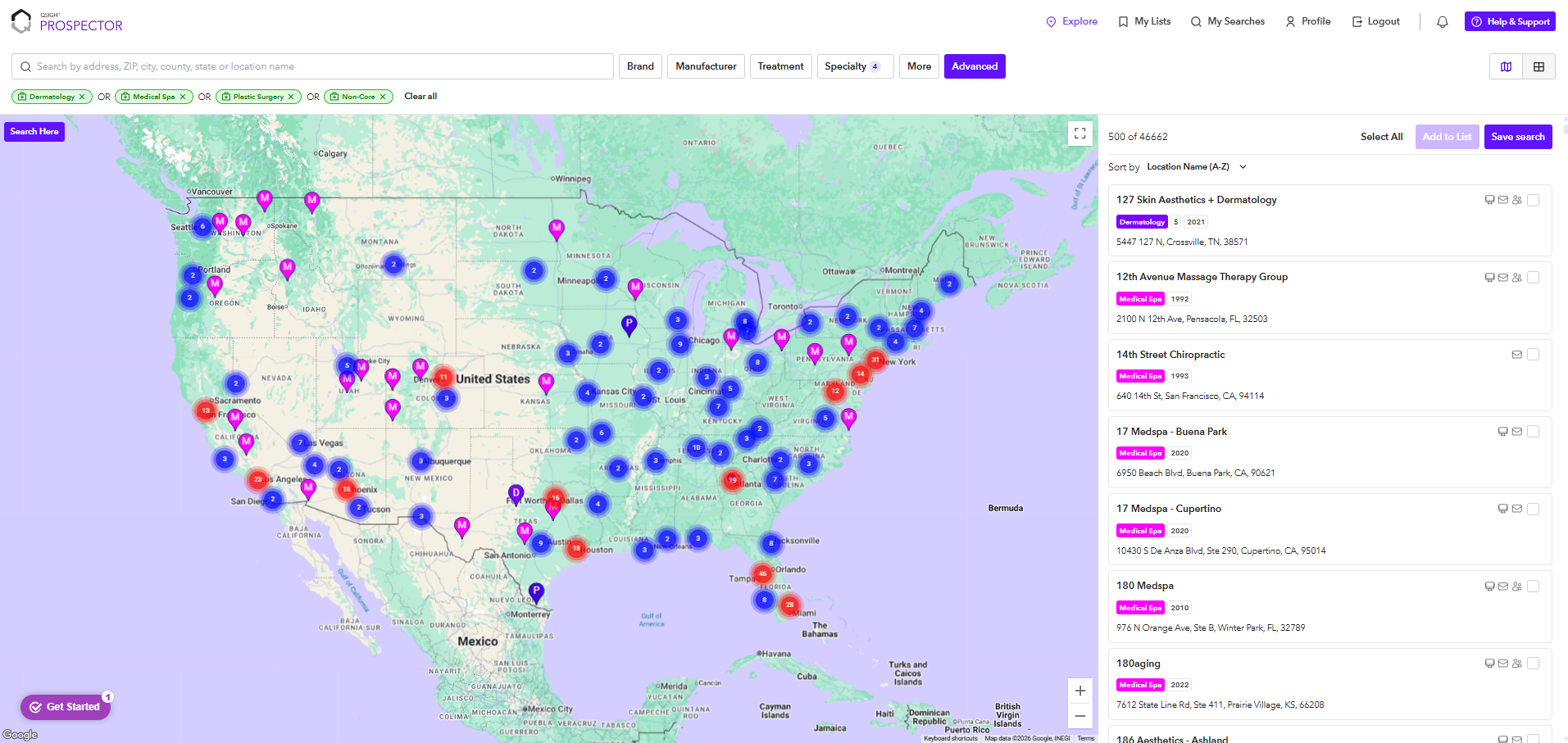
1. Territory Planning Based on Opportunity, Not Just Geography
In aesthetics, practice density, service mix, and growth behavior vary dramatically by region. Some areas are saturated with providers offering near-identical menus. Others have clear white space where certain treatments or technologies remain underpenetrated.
Prospector is a powerful sales territory planning software that helps you visualize these differences before assigning coverage. One of its key features is the mapping tool, which allows you to design territories around:
- Concentrations of aligned practices (not just any practice)
- Areas where competitors, categories, or treatments are underrepresented
- Travel efficiency tied to realistic call plans
- Growth potential instead of historical boundaries
2. Less Time Wasted On Dead-End Leads
One of the most persistent frustrations for sales leaders is sinking their reps’ time into accounts that are:
- Already heavily invested in a given category or modality
- Structurally misaligned with the offering
- Recently committed to a competitor
- Inactive
Prospector lets teams qualify accounts before outreach begins, based on how practices actually look today.
3. More Realistic Planning for Longer Sales Cycles
Economic conditions are changing how practices evaluate purchases. Capital investments face more scrutiny. New product additions have to demonstrate clear revenue impact. Training requirements and operational disruption weigh more heavily in decisions.
This doesn’t eliminate opportunity, but it does change how goals should be phased.
With Prospector insights, sales leaders can:
- Sequence outreach based on signals that suggest relative readiness to invest
- Align senior reps with higher-complexity opportunities
- Set more realistic ramp expectations for new territories
- Avoid front-loading targets in low-conversion areas
Planning with these constraints in mind leads to fewer surprises mid-year and fewer reactive scrambles when forecasts miss.
4. Category-Specific Segmentation That Reflects How the Market Actually Works
Not all aesthetic categories behave the same way. Neurotoxins and fillers require different selling motions than energy-based devices or professional-grade skincare. Weight loss–adjacent services and regenerative treatments introduce new considerations altogether.
Prospector gives sales teams a way to segment the market based on what practices currently offer, rather than treating all accounts as equally relevant. Sales leaders can see how practices align to specific categories today and plan coverage and goals accordingly.
5. Shifting from Activity Metrics to Opportunity Coverage
In 2026, sales strategies are increasingly more focused on coverage quality over raw activity counts. The question is changing from “How many calls did reps make?” to “Are we spending time on the right accounts?”
Prospector gives sales managers a shared, transparent view of the market universe that supports this line of thinking. It lets them evaluate coverage against known opportunity pools rather than abstract benchmarks.
That means leaders can more easily identify gaps, rebalance effort, and coach with context instead of relying solely on lagging indicators.
Planning With Fewer Assumptions and More Control
Medical aesthetics will remain competitive in 2026. Innovation will continue, practices will keep evolving, and trends will change. What isn’t changing is the tolerance for inefficiency.
When it comes time to justify territory design, headcount allocation, and growth forecasts, Qsight Prospector enables you to ground planning in a clear, current view of the practices you sell into.
For organizations building and honing their 2026 plans now, it’s time to start finding not just more prospects but better ones.
Ready to Plan 2026 With Clearer Inputs?
If you’re building 2026 sales goals and want a more accurate view of the potential customers you’re planning around, Qsight Prospector can bring that clarity earlier in the process. Request a demo to see how Prospector supports more focused planning, better territory design, and fewer surprises once the year is underway.