


Relationship-based selling still matters in medical aesthetics. But in a market with tens of thousands of practices and medspas across the U.S.—each offering a different combination of treatments, brands, and services—relationships alone can’t tell you where the real opportunity is.
That gap is where medical aesthetics competitive intelligence does its work. Qsight’s Prospector tool gives sales teams validated, real-time data on practice locations, treatment portfolios, key contacts, manufacturer relationships, financial indicators, and online presence. It’s a leading-edge solution that helps sales teams identify high-potential prospects and streamline their efforts.
If you’re still relying on outdated data and manual lead targeting, you’re ceding ground. The companies that embrace Prospector now will have the competitive advantage—while those who don’t will be scrambling to catch up later.
Key Takeaways: Aesthetic Market Insights for Sales Teams
- Traditional prospecting methods can’t keep pace with how fast the aesthetics market is shifting. Practices add treatments, change ownership, and expand offerings faster than static databases can track.
- Competitive intelligence in medical aesthetics means knowing which practices are growing, which are stalled, and which are already committed to a competitor before you make contact.
- Qsight Prospector gives sales teams filterable, monthly-updated data on over 45,000 U.S. aesthetics practices and medspas, validated at the practice level.
- The most effective prospecting combines market growth signals with decision-maker access, so reps spend time on accounts that are actually winnable.
- Sales leaders using data-driven prospecting can align territory design, goal-setting, and call planning to actual market expansion rather than historical assumptions.
The Challenges of Selling in Today’s Medical Aesthetics Market
Consider what a sales rep needs to know before walking into a practice:
- Which treatments do they offer? Injectables, energy-based devices, professional-grade skincare?
- What brands are they currently using?
- Are they growing or plateauing?
- Who actually makes the purchasing decisions?
Without structured data, answering those questions requires cold calls, outdated CRM records, and a lot of wasted time.
The practices worth targeting have changed, too. The landscape isn’t just medspas and aesthetic plastic surgery groups anymore. It now includes dermatology practices expanding into chemical peels and non-surgical cosmetic procedures, primary care offices adding skin tightening and GLP-1s, and hybrid wellness clinics building out full aesthetic treatment menus.
The increasing popularity of non-invasive treatments among patients is driving market growth across practice types that didn’t always compete in this space. Knowing which practices fit your offering requires more than a zip code and a referral.
What Medical Aesthetics Competitive Intelligence Actually Looks Like
“Market intelligence” is an easy phrase to use but hard to operationalize. Here’s what it really means for aesthetics sales teams using Prospector.
Filtering by Practice Growth Signals
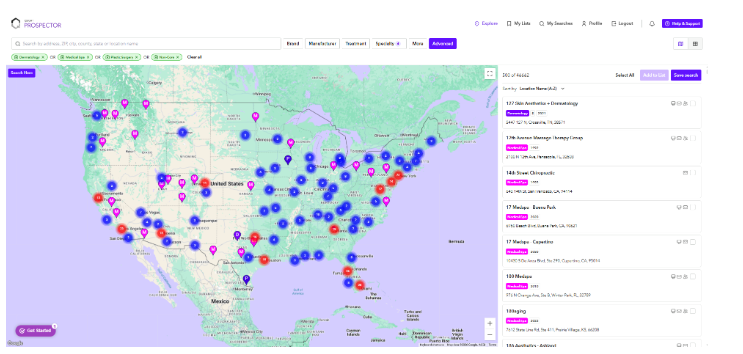
Not every practice on a territory map is a viable prospect. Prospector lets sales teams filter by treatment portfolio, manufacturer relationships, operational status, and financial health indicators. That way, reps can identify which accounts are actively expanding their offerings versus which are fully committed or in decline.
This means you can base sales planning on validated, monthly-updated practice-level data rather than on speculation extrapolated from regional trends or third-party proxies.
Identifying Decision-Makers Before the First Call
One of the most persistent friction points in aesthetic sales is contact accuracy. Reaching the wrong person, or a contact who left the practice months ago, wastes rep time and erodes credibility with the account.
Prospector surfaces key decision-maker information at target practices, so reps can route outreach to the people who actually influence purchasing decisions. Arriving informed is one of the most direct ways to build trust before the first conversation even begins, giving your team fewer dead ends and more productive calls.
Territory Design Built Around Opportunity
When territory lines are drawn around geography alone, reps often end up with uneven workloads: dense clusters of misaligned accounts alongside white space that should be prioritized. Prospector’s map-enabled interface lets sales leaders design territories around concentrations of aligned practices, underpenetrated treatment categories, and realistic travel efficiency.
Whether a new aesthetic clinic opens in Miami or a dermatologist in Los Angeles starts offering biostimulatory dermal fillers, with Prospector, you’ll be the first to know. With this tool, your coverage reflects where opportunity actually is, not where it used to be.
Turning Medical Aesthetics Market Data into Prospecting Decisions
The most actionable shift a sales team can make is moving account qualification upstream, so it happens before the first call. Here’s how that plays out in practice.
Prioritizing Accounts by Fit, Not Just Familiarity
Reps default to accounts they already know. That’s understandable, but it creates blind spots. Prospector allows teams to run searches across the full 45,000+ practice database and filter down to the accounts that match a specific product’s ideal customer profile, by specialty, treatment mix, geography, and more.
Instead of a raw list, you get a prioritized set of prospects that actually align with what you’re selling, which changes how reps plan their weeks and how managers set realistic targets.
Aligning Goal-Setting to Market Reality
When quota and territory goals are set without data, they’re built on assumptions. Adding one new account per week sounds reasonable until you see that your territory’s best-fit practices are already committed to a competitor in that category.
Prospector gives sales leadership visibility into market size and opportunity distribution before goals are finalized. Territory assignments, call plans, and revenue targets can be calibrated against what the data shows, not what last year’s numbers suggested.
The Competitive Landscape: Factors Worth Tracking
In a crowded aesthetic procedure market, timing is a real differentiator. The practices most worth targeting are the ones in motion, who are adding services, shifting brand commitments, or entering a category for the first time. Strong demand for new treatments and technologies like regenerative skincare means practices are actively evaluating new offerings, but those signals don’t show up in static lead lists.
Prospector captures them because the data is refreshed monthly. A new medspa that opens in a high-density metro, a dermatology group that adds minimally invasive procedures or aesthetic devices, or a practice that expands to a second location—those updates are reflected in the platform.
They give sales teams first-mover access to practices that are actively evaluating new devices, new technologies, and most importantly, new partnerships. The competitive advantage isn’t just having more data, but having current data at the moment a practice is most likely to say yes.
Frequently Asked Questions About Aesthetic Sales Prospecting
What is medical aesthetics competitive intelligence?
In the context of sales, medical aesthetics competitive intelligence means validated, structured data about which practices are operating, what they offer, who makes purchasing decisions, and how they’re growing. It goes beyond directories or CRM records to give sales teams the signals they need to prioritize accounts and time outreach effectively.
How does Qsight Prospector differ from a standard lead list?
Most lead lists are static, compiled at a point in time and not updated regularly. Prospector is a live database of over 45,000 U.S. aesthetics practices, refreshed monthly, and filterable by treatment portfolio, practice specialty, manufacturer relationships, financial indicators, and more. The distinction matters because the aesthetics market changes constantly, and stale data leads to wasted outreach.
What types of practice growth signals can sales teams track in Prospector?
Teams can filter and identify practices by the treatments they currently offer, operational status, geographic expansion patterns, and their existing manufacturer relationships. These filters help narrow a large database down to the accounts most likely to be receptive to a specific product or offering.
Can Prospector support territory planning, not just individual prospecting?
Yes. Sales leaders can use Prospector’s mapping tools to design territories around practice density, treatment mix, and growth potential rather than geographic boundaries alone. This is particularly useful for identifying white space: areas where a given treatment category or technology is underrepresented relative to practice volume.
Read more: Why Sales Planning in Medical Aesthetics Needs a Reset
The Case for Moving Now
The aesthetics market isn’t going to get simpler. More brands, more aesthetic enhancements, and more practice types entering the space mean the signal-to-noise ratio on traditional prospecting will keep declining.
Sales teams that build data-driven account qualification into their process now will have a structural advantage over those that don’t—not just in who they target, but in how efficiently they operate across the entire sales cycle. Prospector is where that process starts.
Lead the Market—Don’t Chase It: Request a Demo of Qsight Prospector Today
Establish stronger relationships with key players before competitors reach them. Gain deeper insights into market trends to refine sales strategies. Build long-term efficiency by integrating data intelligence into daily operations. It all starts with a demo. Get in touch today and see the power of real-time sales intelligence in action.