
Not long ago, a celebrity endorsement was the fastest path to aesthetic awareness. Drop a treatment name in a magazine interview, and consumer interest would surely follow. That dynamic hasn’t disappeared, but something more durable has emerged alongside it: the practitioner as a primary driver of demand.
Dermatologists, plastic surgeons, and medspa providers are building social media audiences at a scale that would’ve seemed improbable five years ago. And the data increasingly shows that their voices don’t just attract followers—they change behavior.
For brands operating in medical aesthetics, this shift has real implications for how awareness is built, where marketing investment should flow, and which conversations are worth tracking.
Key Takeaways
- Social media intelligence is how you know where the market is going before it arrives.
- Celebrity moments like the PDRN facial trend generate awareness, but practitioners convert that awareness into booked procedures.
- Dermatologists command a 12-to-1 trust advantage over social media influencers for skincare advice.
- Top practitioner accounts now reach millions of followers, with measurable impact on procedure demand.
- Social media data tools like Qsight Social Intelligence surface these engagement trends, oftentimes before they appear in sales data.
The PDRN Facial: A Case Study in How Awareness Actually Works
Few examples illustrate the new awareness model better than the PDRN facial. Also called the “salmon sperm facial,” PDRN (polydeoxyribonucleotide) treatments had been established in South Korea and parts of Europe well before they became a Western cultural moment.
That moment arrived in 2023, when Jennifer Aniston described the treatment in WSJ Magazine, calling it “the future” of anti-aging. Kim Kardashian amplified it in 2024, when she said that she’d received PDRN injections on an episode of The Kardashians. Miley Cyrus, Kesha, Charli XCX, and Denise Richards have since discussed their own experiences publicly.
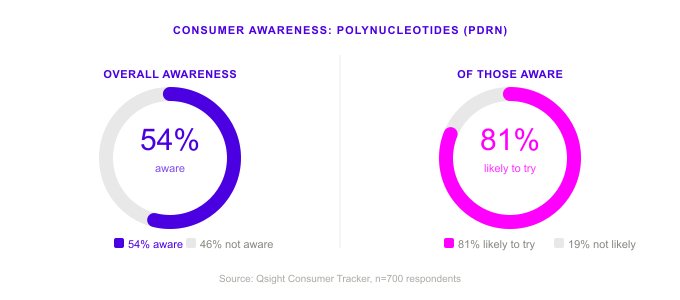
Consumer awareness followed fast. According to Qsight Consumer Tracker data, 54% of aesthetic consumers are now aware of polynucleotides—a remarkable figure for a procedure with near-zero U.S. name recognition just two years ago. Of those aware, the overwhelming majority reported being likely to try the treatment.
Why Celebrity Alone Didn’t Spark a Full-Blown Trend
Later coverage of the PDRN trend in outlets like The Hollywood Reporter prominently featured Beverly Hills practitioners who provided clinical context, explained the mechanism, and added the layer of credibility that moves consumers from curious to committed.
The celebrity creates the search, but the practitioner is what seals the deal.
Why Practitioner Voices Carry So Much Weight
Not all influencers are equal in aesthetics. Lifestyle creators may drive awareness, but when a dermatologist or injector discusses a treatment protocol, audiences perceive the information differently.
A few data points make this clear:
- In the 2025 Edelman Trust Barometer Special Report on Trust and Health, 69% of people said “medical scientists and health experts” influenced their health decisions, while only 21% cited “content creators without medical training.”
- Avon’s 2024 beauty consumer survey across seven countries found dermatologist trust at 60% for skincare advice (36% in-person, 24% online), versus 5% for social media influencers. That’s a 12-to-1 advantage.
- The American Society for Dermatologic Surgery has found across multiple annual surveys that board-certified dermatologists rank as the primary influencing factor in cosmetic procedure decisions. By 2025, they were the preferred physician type across 12 procedure categories.
- A 2025 JMIR Dermatology study analyzing over 22,000 TikTok dermatology videos found that dermatologist-run accounts generated an average of 25.9 million views, compared with 5.0 million for non-dermatologist accounts.
The Scale of Practitioner Social Presence
These days, clinical credibility generates trust and reach. Practitioner influencers have reached mainstream scale, with followings that rival traditional celebrities.
- Dr. Muneeb Shah: 21M+ followers combined across TikTok, Instagram, and YouTube.
- Dr. Sandra Lee (Dr. Pimple Popper): ~17M TikTok followers, ~5M Instagram.
- Dr. Simon Ourian: ~4M Instagram followers; the Beverly Hills cosmetic dermatologist publicly associated with the Kardashian-Jenner family.
- Dr. Shereene Idriss: 2M Instagram, 1.2M TikTok, and a skincare line now carried in U.S. Sephora locations.
- Dr. Dustin Portela: 2.4M TikTok followers; credits social media with growing his practice from 5 employees to 30+ across multiple locations.
These accounts are popular, yes. But more importantly, they’re commercially consequential.
What Does Qsight Data Say About Who’s Driving Engagement?
The Qsight Social Intelligence Trends Report confirms that medspas generate the highest volume of social posts across the aesthetics category. But dermatologists and plastic surgeons achieve the highest average engagement per post. That proves volume and influence aren’t the same metric. For brands, it’s a distinction that matters.
What Actually Engages People on Aesthetic Social Media?
Knowing that practitioners drive higher engagement is only useful if you understand which kinds of practitioner content perform. Qsight Social Intelligence data from 2025 Instagram activity makes this clear, and the answer goes against many traditional assumptions.
Staff spotlight and culture posts generate the highest average engagement of any content category. These posts outperform before-and-after content (the most frequently posted type of content), procedure demos, product launches, and influencer or sponsored collaborations. Public relations content and audience-facing questions also rank in the top tier. Testimonials, sales promotion, and personal selling content rank near the bottom.
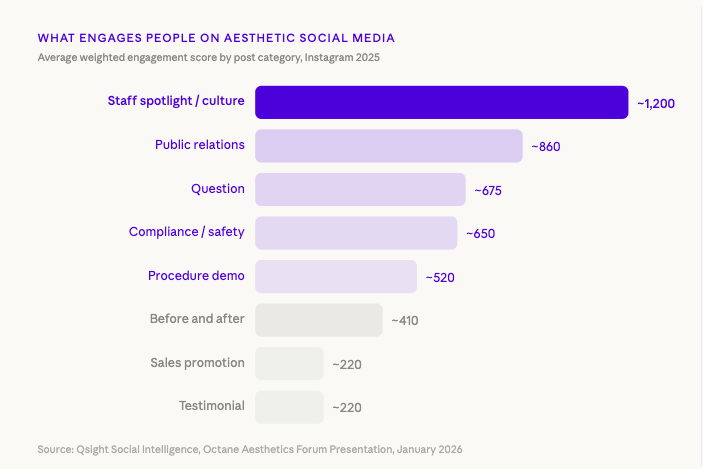
All of this means that the content driving the most engagement isn’t product-forward but identity-forward. Audiences engage most when they feel like they know the person behind the practice.
For manufacturers and brand teams, this creates real strategic questions:
- Are you supporting practitioners in creating the content that actually engages, or providing promotional assets that underperform?
- Are your sales teams targeting practices that hold real sway over their audiences?
- Are you timing campaigns with peak engagement months?
The Path from Brand to Audience Now Runs Through Practitioners
The PDRN trend illustrates a broader trend in how aesthetic brands build awareness today, and it’s not the only example.
Historically, innovation flowed primarily from manufacturers to practitioners and then to patients. Today, the flow of influence is more dynamic. Practitioners, patients, and online communities all contribute to shaping treatment demand.
For manufacturers and investors, this environment requires a deeper understanding of digital conversation patterns.
Social intelligence data provides that perspective. By analyzing practitioner engagement, companies gain visibility into how treatments gain momentum and how patient interest evolves across social platforms.
These insights support several strategic priorities:
- Identifying emerging procedures before they reach peak demand
- Understanding how practitioner narratives shape brand perception
- Recognizing which practitioner influencers are driving conversation
- Aligning marketing campaigns with real engagement patterns
As aesthetics continues to expand—U.S. medical aesthetic spending reached roughly $21 billion in 2025—the ability to monitor these patterns becomes increasingly valuable for market participants.
Why does the social data matter if I have sales data?
Traditional market research often measures outcomes after demand has already formed. Social media intelligence changes that timeline. By tracking practitioner-generated content and engagement patterns, companies can identify early signs of emerging treatments and shifting patient interest.
For example, Qsight Social Intelligence data shows that Sculptra surpassed Juvéderm in Share of Voice on Instagram across most months of 2025, showing growing momentum for biostimulatory injectables over traditional hyaluronic fillers. That competitive shift appeared in social conversation before it was broadly visible in patient transaction data, making it precisely the kind of early shift social intelligence is built to surface.
Simply put, the social signal often leads the sales signal. For commercial teams prioritizing account outreach, marketing teams planning campaign timing, and strategy teams validating category assumptions, seeing where practitioner engagement is building before it shows up in revenue is a meaningful advantage.
Understanding Practitioner Influence With Qsight Social Intelligence
Practitioner voices are now central to how aesthetic treatments gain awareness, credibility, and adoption. For organizations operating in the aesthetics ecosystem, understanding these conversations is essential for anticipating demand and responding strategically to emerging trends.
Guidepoint Qsight’s Social Intelligence capability provides that visibility by tracking 37,000+ practice and practitioner influencer profiles and millions of posts across social platforms—and translating those patterns into actionable insight.
The practitioner is already shaping demand. The question is whether your teams are watching closely enough to act on it.
See What the Market Sees Next. Request a Demo of Qsight Social Intelligence
Qsight Social Intelligence gives commercial and marketing teams a real-time view of practitioner and consumer engagement across Instagram, Facebook, and TikTok. From Share of Voice tracking to content engagement benchmarks, it’s built to help aesthetics brands act on trends before they show up in sales data. Request a demo to see what’s moving in your category right now.